2-2-3 and week-on/week-off custody schedules, explained
Updated October 12, 2026 · 3-minute read
Two schedules come up a lot when parents share time about equally: the 2-2-3 and the week on / week off. Both give each parent 7 days out of every 14. The difference is how often the children move between homes. Here is how each one works, with a simple two-week calendar.
How a 2-2-3 custody schedule works
The week is split into blocks of 2 days, 2 days and 3 days. The parents take turns, and the order flips every week.
- Week 1: Parent A has Monday and Tuesday. Parent B has Wednesday and Thursday. Parent A has Friday through Sunday.
- Week 2: the same blocks, swapped. Parent B starts the week and has the weekend.
| Week | Mon | Tue | Wed | Thu | Fri | Sat | Sun |
|---|---|---|---|---|---|---|---|
| Week 1 | A | A | B | B | A | A | A |
| Week 2 | B | B | A | A | B | B | B |
A = Parent A · B = Parent B. Then Week 1 starts again.
How a week on / week off custody schedule works
Each parent has the children for a full week, then the other parent has them for the next full week. Families pick one exchange day, for example Monday at school drop-off, Friday after school or Sunday evening.
| Week | Mon | Tue | Wed | Thu | Fri | Sat | Sun |
|---|---|---|---|---|---|---|---|
| Week 1 | A | A | A | A | A | A | A |
| Week 2 | B | B | B | B | B | B | B |
A = Parent A · B = Parent B.
Side by side
| Measure | 2-2-3 | Week on / week off |
|---|---|---|
| Days with each parent | 7 and 7 | 7 and 7 |
| Exchanges | 6 | 2 |
| Most days in a row with one parent | 3 | 7 |
| Weekends | Alternate | Alternate |
That's the whole trade-off on paper: the 2-2-3 means shorter time apart from each parent and more exchanges. Week on / week off means fewer exchanges and longer stretches.
Custody calendar examples
The calendars above show two weeks. Over a full month the same pattern repeats. Here is November 2026 on a 2-2-3 schedule that starts on Monday, November 2 (November 1 ends the week before, with Parent B).
| Mon | Tue | Wed | Thu | Fri | Sat | Sun |
|---|---|---|---|---|---|---|
| 1B | ||||||
| 2A | 3A | 4B | 5B | 6A | 7A | 8A |
| 9B | 10B | 11A | 12A | 13B | 14B | 15B |
| 16A | 17A | 18B | 19B | 20A | 21A | 22A |
| 23B | 24B | 25A | 26A | 27B | 28B | 29B |
| 30A |
A = Parent A · B = Parent B. In this example each parent has 15 days in November.
On a week on / week off schedule, the same month is simply whole weeks of A and whole weeks of B. To map your own year, print a blank calendar and color each day by who the children were with.
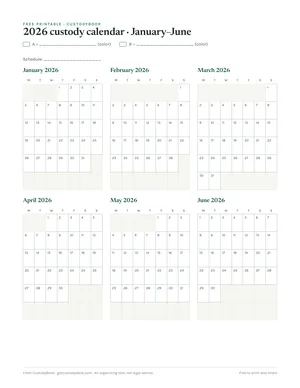
Free printable: 2026 custody calendar
All 12 months on 2 pages, US Letter, with an A/B color key. No email, no sign-up.
Things families often think about
- The children's ages and daily routines.
- How far apart the two homes are, and how far each is from school.
- Where and when exchanges happen: at school, at home or at a set place.
- Holidays, school breaks and birthdays, which many families plan separately.
Which schedule fits is a decision for the parents, and sometimes for a mediator or lawyer. This guide only explains how the two patterns work.
When the real week doesn't match the plan
Plans change: a sick day, a trip, a swapped weekend. A calendar is most useful when it shows what actually happened, not only what was planned.
- Mark who the children were actually with each day.
- Write down exchanges that were on time, late, didn't happen, or were cancelled with notice.
- Keep notes short and factual: date, time, place.
Doing this in CustodyBook
CustodyBook is a private custody log for one parent, with a custody calendar in the app that fills in the coming weeks. In the app you can:
- Pick your pattern (2-2-3 or week on / week off) and CustodyBook fills in the coming weeks.
- Log a custody day in one tap, and correct any day with one tap when plans change.
- Mark exchanges as on time, late, no-show or cancelled with notice.
- See nights with each parent by month and by year.
- Export a clean monthly PDF you can share with your lawyer.
Free for 7 days, then $14.99 once. No subscription.